




A practical guide for home-based wire artists who sell to shops, shows, and direct customers.

Wholesaling can feel difficult when you are unsure of the process. With a few trade habits, it becomes manageable. Make sales calls to boutiques and shops in your area and aim to sell outright. Consignment is rarely ideal. Consider a Saturday trunk show, sell from your case, and offer the shopkeeper a percentage. If the show performs, they will likely invite you back and may buy on the spot.
When selling retail, praise from customers can feel effortless. In wholesale, feedback is blunt and cost focused. If you undercharge, you risk your business. If the shop overpays, they risk theirs. Creating art and selling art are different. In a small, home-based business, you often do both.
Reality check and opportunity notes
Some wire artists report $30,000 in wholesale at a single show. Many earn $7,000 to $10,000. Results vary, but good systems, honest pricing, and repeatable designs help.
Some buyers never think a price is low enough. They complain, nickel and dime, and still sell your work. Protect your energy. If an account drains you and affects your craftsmanship, end it.
A prestige gallery run as a pastime may not prioritize sales. Your work can end up in a back room. Openings draw friends, not buyers. These accounts rarely push or price seriously.
Expect the casual “Throw this in too.” Set boundaries. If you allow one free piece, next time it may be two. Write clear invoices and kindly enforce them.
“Put some things in my shop” often means limited cash, poor flow, or low confidence in your fit. Consignment rarely works out. Offer a trunk show. If it sells, switch to purchases.
Net-30 is common. Many pay late. Start small. A $200 invoice is easier to collect than an $800 one. Follow up professionally. At 60 days with no payment, retrieve your work and close the account.
Simple script for first orders
Require a credit card on file for first orders. Offer 30 or 60 days. If no payment arrives, charge the card. Reputable buyers accept this. If they refuse and have no card, move on.
New owners may buy enthusiastically. Protect them and yourself. Ask who their customers are, what neighborhood they serve, and which terms work. Offer swaps if items do not sell, help with correct terminology, and advise on displays.
- Guarantee your wire craftsmanship.
- Swap unsold styles to find a fit.
- Coach on language, for example, “laboratory created” and “gold filled.”
Pricing one-of-a-kind work is hard. Perceived value matters. Research expectations in your market. Consider experience, quality, speed, reputation, and credibility. Also factor selling context. At a large gem show your cost to sell can reach 35% of gross. A neighbor purchase is closer to pure profit.
- How long have you been making wire jewelry?
- Have people offered to buy your pieces?
- Are wraps even and wires flowing cleanly?
- Is the gemstone straight and undamaged?
- How quickly can you complete a pendant?
- Do you have a reputation as an artist and as a business?
One effective system tracks exact wire length by gauge, plus stone cost, per piece.
- Retail: (Materials × 3) + flat labor, for example, $20.
- Wholesale: Materials × 2 + negotiated labor per piece count.
Example: $10 materials → retail $50, wholesale $30–$40 depending on volume and labor.
For very fast makes, another method adds gemstone and wire cost, then multiplies by four for retail.
Pre-measure average wire usage for 2-, 3-, and 4-wire pendants across small, medium, and large stones in each gauge. Convert to cost per project. Use this lookup to quote quickly and consistently.
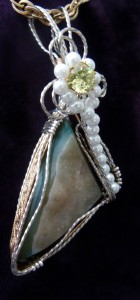
Know your retail market for each stone and setting. I often work in gold-filled wire, which affects price. Focus on what the piece will sell for, not what you paid. Learn by selling at shows and by staying informed through trade publications and peer conversations.
- Retail reference: about $1.25–$1.50 per carat in a wire setting.
- 20 ct stone at $1.50/ct = $30, plus a standard pendant setting at $45.
- Target retail: $75.
If the stone cost $10 and wire $5, hard cost is $15. At $75 retail, that is strong margin for a well-crafted gold-filled piece with a clean bail and no chips.
- Common retail depends on quality, shape, and weight.
- Typical prong ring setting labor in gold-filled or sterling: about $65.
- Target retail: ~$107; many sellers use $99 at shows for appeal.
Time investment is higher than a small pendant. Price accordingly.
- Sell stones by carat for clarity and margin. Example: 15 ct × $3/ct = $45.
- Gold-filled wire bracelet setting: ~ $125 baseline, varies by band wires and size.
- Target retail: ~$170.
Bracelets take longer. Some designs are not ideal for wholesale discounts. Favor quick, repeatable bracelet styles for wholesale.
When a piece exceeds your usual standard, price the creativity. Consider doubling or tripling your typical formula. Test the market carefully and adjust over time.
Why creative premiums matter
Creative breakthroughs are how you raise perceived value and earn more per hour. If you never price them higher, it is hard to move your price ceiling.
- Use “laboratory created,” not “synthetic,” when appropriate.
- Use “gold filled” or “rolled gold,” not “gold plated,” when accurate.
- Teach display best practices, for example, ring holders, collar stands, cases.
- Clear guarantees on wire construction quality.
- Swap unsold items to find a selling formula per shop.
- First-order terms with a card on file. Net 30–60 with accountability.

The premier place for all your jewelry making needs. The best in wire, tools, cabochons, gemstone beads and more. As well as a superior resource for educational support to help build your jewelry making skills and techniques.
Connect With Us

® 2007 - 2026 Wirejewelry.com Powered by ClaimTheWeb Cart