




Gem Profile- Topaz
How do red, pink, yellow, and white relate to one of the hardest minerals on earth, as well as a mountain in Utah? The answer is Topaz! Topaz is considered a gemstone with a hardness of 8.
Topaz has perfect cleavage, an orthorhombic crystal system, and is composed of aluminum, silicon, hydrogen, oxygen, and fluorine. Pure topaz is colorless, clear, white, or silver, while colored topaz occurs naturally through impurities. Clear topaz can also be irradiated or heated to enhance or change its color.
The name "topaz" likely comes from the Greek *topazios*, the name of an island in the Red Sea now known as St. John's or Zabargad. Historically, "topaz" has also referred to peridot and citrine. Its name may relate to the Sanskrit word for "heat" or "fire," fitting because topaz forms in vapor cavities of rhyolitic lava flows and is often associated with a glowing orange color. Topaz has even been mistaken for diamond, such as the large stone in the Portuguese crown called the "Braganza Diamond."
Imperial Topaz, primarily from Brazil, is a rich golden color and usually untreated, making it the most prized type of naturally colored topaz. Champagne Topaz ranges from pale tan to medium brown, with most supplied by Mexican mines.
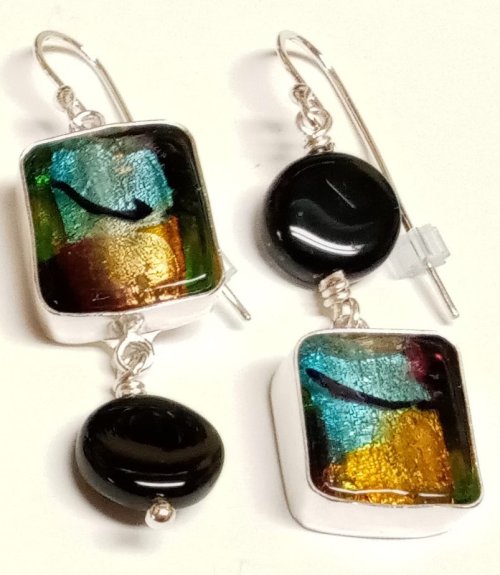
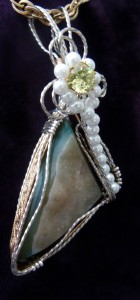
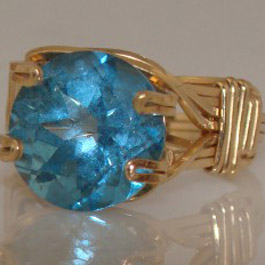
Cindy Massey's mother-in-law brought a topaz stone back from India, and Cindy wire-wrapped it in sterling silver as a gift for her sister-in-law.
The name "topaz" likely comes from the Greek *topazios*, the name of an island in the Red Sea now known as St. John's or Zabargad. Historically, "topaz" has also referred to peridot and citrine. Its name may relate to the Sanskrit word for "heat" or "fire," fitting because topaz forms in vapor cavities of rhyolitic lava flows and is often associated with a glowing orange color. Topaz has even been mistaken for diamond, such as the large stone in the Portuguese crown called the "Braganza Diamond."
Imperial Topaz, primarily from Brazil, is a rich golden color and usually untreated, making it the most prized type of naturally colored topaz. Champagne Topaz ranges from pale tan to medium brown, with most supplied by Mexican mines.
Cindy Massey's mother-in-law brought a topaz stone back from India, and Cindy wire-wrapped it in sterling silver as a gift for her sister-in-law.

Pink Topaz is hardly ever found in naturally, so when the color is natural, the stone is expensive.
Most of the pink topaz on the market began originally as yellow stones that turned pink with heat treatment. Azotic Topaz is another type of treated topaz: a natural topaz receives a thin titanium coating, giving the stone more color and shine.
Topaz can be found in almost every continent, with the exception of Antarctica. Some of the more important finds have been in Brazil, Mexico, Russia, and the United States.
Topaz can be found in astonishingly large sizes, like the 100kg blue topaz found in the Ukraine.
The Smithsonian in Washington, D.C. has several cut topaz stones on display, the largest of which is a yellow topaz weighing in at 22,892.50 carats - what a rock!
Azotic and pink Topaz
Most of the pink topaz on the market began originally as yellow stones that turned pink with heat treatment. Azotic Topaz is another type of treated topaz: a natural topaz receives a thin titanium coating, giving the stone more color and shine.
Topaz can be found in almost every continent, with the exception of Antarctica. Some of the more important finds have been in Brazil, Mexico, Russia, and the United States.
Topaz can be found in astonishingly large sizes, like the 100kg blue topaz found in the Ukraine.
The Smithsonian in Washington, D.C. has several cut topaz stones on display, the largest of which is a yellow topaz weighing in at 22,892.50 carats - what a rock!
Azotic and pink Topaz

Road trip, anyone? Topaz can be found in the deserts of Utah, especially at Topaz Mountain, part of the Thomas Range.
Crystals here are naturally golden amber, but sunlight can make them transparent, losing all color.
Most crystals are under an inch long and can be found in loose rock and gravel along the mountain.
Break open white rhyolite to find larger crystals inside.
Orange Topaz is the birthstone of November, symbolizing friendship and peace, and is also Utah's state gemstone.
Golden-yellow Topaz is said to enhance personal intentions in alignment with divine will and attract beneficial new friendships.
White Topaz encourages acceptance and spiritual guidance for purpose and mental clarity.
Biblically, the High Priest's breastplate was thought to contain Topaz, which is associated with love and truth.
Crystals here are naturally golden amber, but sunlight can make them transparent, losing all color.
Most crystals are under an inch long and can be found in loose rock and gravel along the mountain.
Break open white rhyolite to find larger crystals inside.
Orange Topaz is the birthstone of November, symbolizing friendship and peace, and is also Utah's state gemstone.
Golden-yellow Topaz is said to enhance personal intentions in alignment with divine will and attract beneficial new friendships.
White Topaz encourages acceptance and spiritual guidance for purpose and mental clarity.
Biblically, the High Priest's breastplate was thought to contain Topaz, which is associated with love and truth.
Resources & Recommended Reading
Topaz at Topaz Mountain at geology.utah.gov
Yellow Topaz at www.healing-crystals-for-you.com
Topaz on Wikipedia
Topaz on Mindat
Topaz at Topaz Mountain at geology.utah.gov
Yellow Topaz at www.healing-crystals-for-you.com
Topaz on Wikipedia
Topaz on Mindat
Materials

Wire

Sterling Silver Bezel Connector Lemon Topaz Pear 10X7mm - Pack of 1
K4-78
- Lesson Quantity: 1.00 pieces
- Purchase Quantity: 1.00 each
- Price: $2.80
- Gold Club Price: $2.10

Topaz colored Swarovski

Beads

Cabochons
Tools

WireJewelry - Ultimate Wire-Pliers Jewelry Pliers with Case, Set of 5
G15-20
- G15-20
- Lesson Quantity: 1.00 pieces
- Purchase Quantity: 1.00 each
- Price: $170.72
- Gold Club Price: $128.04

Bench Tools
Supply Detail
loading...
Change Metal:
This Article requires:
Purchase quantity:
Price: $
Gold Club Price: $
Purchase quantity:
Price: $
Gold Club Price: $
- Category: General Education
- Technique(s): General Education
Other Articles by Judy Ellis
 About Jewelry Chain- About Ball Chain
 About Jewelry Chain- Snake Chain and Omega Chain
 About Jewelry Chain- Bar Chain and Peanut Chain
 About Jewelry Chain - Cable Chain and Rolo Chain
 About Jewelry Chain- Curb Chain and Gourmette Chain
 About Jewelry Chain- Figaro Chain
 About Jewelry Chain- Infinity Chain and Anchor Chain
 About Jewelry Chain- Chain Reference Sheet
 About Jewelry Chain- Venetian Chain and Box Chain
 About Jewelry Chain- Wheat Chain and Rope Chain
 Introduction to Chain
 Access More Money by Making Jewelry When Your Prices Are Right
 An Introduction to Beads and Beading
 Common Gemstone Misconceptions
 Wire Wrapped Christmas Tree
 How To Polish Metal Jewelry using a Rotary Tumbler
 How To Polish Your Own Rocks using a Rotary Rock Tumbler
 How to Merchandise Your Jewelry on the Internet
 How to Use Twitter as a Wire Jewelry Artist
 20 Ideas to get your Jewelry Biz Busy
 Watching the Precious Metals Market
 Jewelry Design Ideas - Get Inspired
 Measuring Tools
 July Birthstone - The Ruby
 February Birthstone- Amethyst
 March Birthstone - Aquamarine and Bloodstone
 September Birthstone - Sapphire
 November Birthstones - Topaz and Citrine
 October Birthstones - Rose Zircon, Pink Tourmaline and Opal
 April Birthstone - The Diamond
 August Birthstone - Peridot and Sardonyx
 June Birthstones - Alexandrite, Pearl and Moonstone
 Metalsmithing
 Featured Tool - Mini TruStrike Hammers
 Natural Jasper Stones - Cabochon Gemstones
 Organize Your Jewelry Box
 Pearls- It's a Cultural Thing
 Soldering 101
 Starting Your Own Home Jewelry Business
 The Art of Creating Chainmail
 Why Should I Be Using Facebook
 Make Handmade Neck Cords on a Dime
 Tagging Handmade Jewelry Gifts
 Share Your Expertise with Your Community
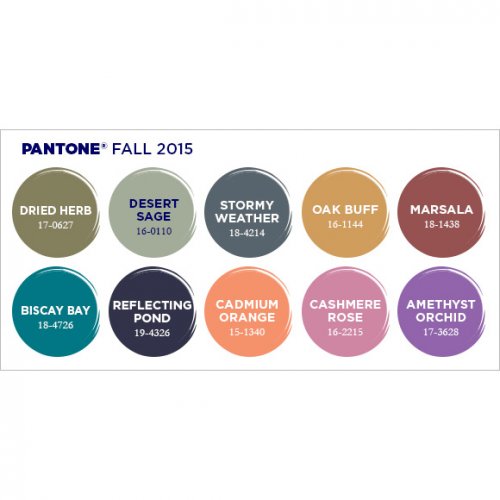 Creating Color Schemes for Jewelry Making
 Bronze, Brass, Nickel Silver and Copper Base Metals
 Gemstone Treatments
 How Wire is Made
 Beading A-B-C's
 How to Set Up Your Workspace
 Gem Profile- Diamond
 Gem Profile- Peridot
 Gem Profile- Goldstone
 Gem Profile- Cryptocrystalline Quartz Introduction
 Gem Profile- Banded Agate and Brecciated Agate
 Gem Profile- Emerald
 Gem Profile- Titanite or Sphene
 Gem Profile- Morganite
 Gem Profile- Desert Rose
 Gem Profile- Iolite
 Gem Profile- Zultanite
 Gem Profile- Maw Sit Sit
 Gem Profile- Tanzanite
 Gem Profile- Aquamarine
 Gem Profile- Turquoise
 Gem Profile- Turquoise Types
 Gem Profile- What's Druze
 Gem Profile- Basalt
 Gem Profile- Fordite
 Gem Profile- Variscite
 Gem Profile- Pearls
 Gem Profile- Onyx
 Gem Profile- Sunstone
 Gem Profile- Sonora Sunrise
 Gem Profile- Rhodonite
 Gem Profile- Glass, Crystal and Quartz
 Gem Profile- Psilomelane
 Gem Profile- Fulgurite
 Gem Profile- Cat's Eye
 Gem Profile- Carnelian
 Gem Profile- Petoskey Stones and Indonesian Fossil Coral
 Gem Profile- Rutilated Quartz
 Gem Profile- Chrysocolla
 Gem Profile- Jet
 Gem Profile- Chrysoprase
 Gem Profile- Rhyolite
 Gem Profile- Chalcedony
 Gem Profile- Lepidolite and Sugilite
 Gem Profile- Unakite
 Gem Profile- Cowrie Shells, Conch Shells, and Drilling Shells
 Gem Profile- Mother of Pearl
 Gem Profile- Moss Agate and Plume Agate
 Gem Profile- Thundereggs and Mexican Lace Agate
 Gem Profile- Dumortierite
 Gem Profile- Apatite
 Gem Profile- Blue Topaz
 Gem Profile- Aragonite
 Gem Profile- Zircon and Cubic Zirconia
 Gem Profile- Howlite
 Gem Profile- Sodalite
 Gem Profile- Magnesite
 Gem Profile- Cuprite
 Gem Profile- Nuummite
 Gem Profile- Bronzite
 Gem Profile- Kyanite
 Gem Profile- Hematite
 Gem Profile- Derbyshire Blue John
 Gem Profile- Eilat Stone
 Gem Profile- Vesuvianite
 Gem Profile- Strontium Titanate -Fabulite
 Gem Profile- Tourmaline
 Gem Profile- Larimar
 Gem Profile- Garnet
 Gem Profile- Tsavorite and Green Garnets
 Gem Profile- Seraphinite
 Gem Profile- Serpentine
 American Wire Gauge
 Viking Knit and Spool Knit Chain
 Copper Roses
 How to Make Medical ID Bracelets Special
 Remembering the Fallen
 6 Ways to Find Your Uniqueness in Jewelry
 Gem Profile- Moissanite
 Birthstone Swarovski Colors
 Gem profile- Paua and Abalone
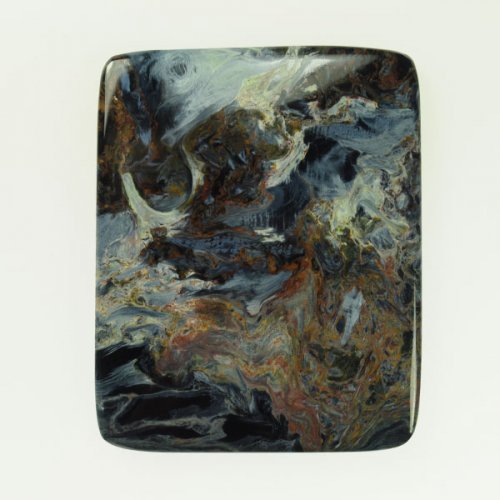 Tips for Tucson Shopping- Gem Show Secrets
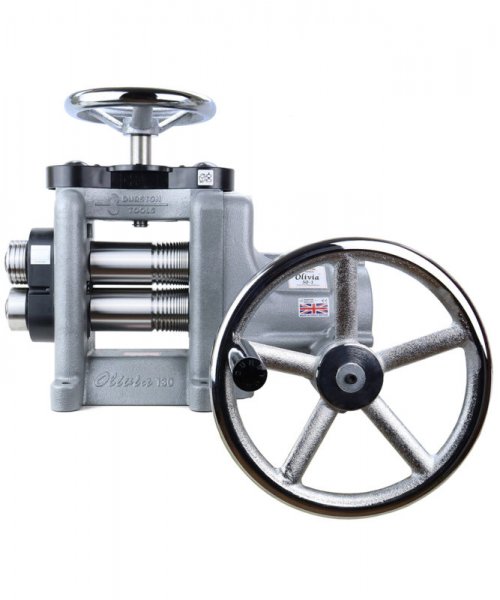 Durston Olivia Rolling Mills
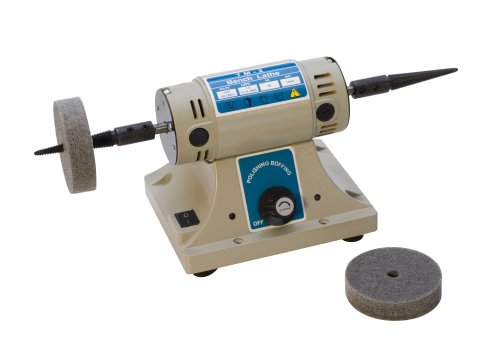 How to Use a Jewelry Bench Polisher Effectively
 5 Jewelry Patterns to Keep Summer Going
 Why Jewelry Makers Love Boho And Free-Form Designs
 5 Fall Leaf Jewelry Patterns to Capture the Colors of Autumn
 Bold Gemstone Wire Jewelry Tutorials for Beginners
 Why Remodeling Old Designs Saves You Money and Sparks Creativity
 Make Something Magical This Halloween Season
 Our Most-Loved Jewelry-Making Patterns of 2025
 Our Most-Loved Jewelry-Making Tips And Techniques of 2025

The premier place for all your jewelry making needs. The best in wire, tools, cabochons, gemstone beads and more. As well as a superior resource for educational support to help build your jewelry making skills and techniques.
Connect With Us

® 2007 - 2026 Wirejewelry.com Powered by ClaimTheWeb Cart