




Gem Profile- Opalized Fossils
This article is one of a six-part series on Opal. Here is a complete list of our Opal articles: An Opal Introduction, Common Opal, Black Precious Opal, White Precious Opal, Opalized Fossils, Boulder Opal
Opalized Fossils
When most people think of opal, they picture the beautiful stones featured in previous articles. But opal doesn't only form in seams, vugs, and cracks it can also be found as fossils.
A fossil is prehistoric physical evidence of life before recorded human history, including animals, plants, petrified objects, and traces like footprints or charred wood.
As described in *The Fossil Book*, fossils are "the remains or traces of organisms that lived during past geologic times and were buried in rocks that accumulated in the earth's outer portion, or crust." This article focuses mainly on petrified and "cast" remains.
A cast fossil forms when organic material, such as a tree limb or shell, is trapped in sediment that hardens. The object decays, leaving a cavity or mold, which later fills with minerals like silica. When the liquid evaporates, a cast is created. In some regions, these casts are made of opal and are called opalized fossils.
Australia and Nevada, USA, are well-known for opalized fossil finds. In Coober Pedy, Australia, opalized fossils are often clam, mussel, or snail shells, where silica-rich water seeped in, replacing the original shell as it decayed. Often, parts of the original shell remain.
Nevada's opalized fossils are mostly petrified wood casts, sometimes showing remarkable detail of the original wood in a variety of colors, including the "black" Virgin Valley specimens. Opalized wood can also be found in New Mexico, Texas, and Arizona.
When most people think of opal, they picture the beautiful stones featured in previous articles. But opal doesn't only form in seams, vugs, and cracks it can also be found as fossils.
A fossil is prehistoric physical evidence of life before recorded human history, including animals, plants, petrified objects, and traces like footprints or charred wood.
As described in *The Fossil Book*, fossils are "the remains or traces of organisms that lived during past geologic times and were buried in rocks that accumulated in the earth's outer portion, or crust." This article focuses mainly on petrified and "cast" remains.
A cast fossil forms when organic material, such as a tree limb or shell, is trapped in sediment that hardens. The object decays, leaving a cavity or mold, which later fills with minerals like silica. When the liquid evaporates, a cast is created. In some regions, these casts are made of opal and are called opalized fossils.
Australia and Nevada, USA, are well-known for opalized fossil finds. In Coober Pedy, Australia, opalized fossils are often clam, mussel, or snail shells, where silica-rich water seeped in, replacing the original shell as it decayed. Often, parts of the original shell remain.
Nevada's opalized fossils are mostly petrified wood casts, sometimes showing remarkable detail of the original wood in a variety of colors, including the "black" Virgin Valley specimens. Opalized wood can also be found in New Mexico, Texas, and Arizona.
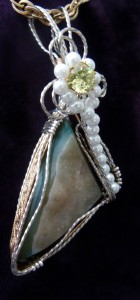
Opalized wood from New Mexico, cabbed by Charlie Armstrong and made into a gold-filled wire pendant by Dale Cougar Armstrong, accented with amethyst.

The definition of a fossil has been debated for years. Lightning Ridge, Australia, claims to have the only "black" fossil opal in the world, so they may not consider Nevada's opalized wood true fossils.
Prehistoric Lightning Ridge was under an inland sea. Today a hot, dry desert, the area yields remarkable fossils, many opalized.
These include dinosaur and shark teeth, various sea shells, pinecones, crocodiles, turtles, marine fishes, and even opalized reptile or dinosaur skin. Imagine uncovering a plesiosaur or dog shark skeleton and finding it opalized!
Many good specimens are damaged during excavation as miners focus on opals with vibrant color, and much of the fossil material is common opal.
The Lightning Ridge region includes opal fields and towns such as Coober Pedy, White Cliffs, Andamooka, Mintabie, and Lambina.
For some stunning examples of opalized fossils from the Australian Museum, please click the following link: opalized dinosaur toe, found in New South Wales, is 8cm (3 inches) long!
Prehistoric Lightning Ridge was under an inland sea. Today a hot, dry desert, the area yields remarkable fossils, many opalized.
These include dinosaur and shark teeth, various sea shells, pinecones, crocodiles, turtles, marine fishes, and even opalized reptile or dinosaur skin. Imagine uncovering a plesiosaur or dog shark skeleton and finding it opalized!
Many good specimens are damaged during excavation as miners focus on opals with vibrant color, and much of the fossil material is common opal.
The Lightning Ridge region includes opal fields and towns such as Coober Pedy, White Cliffs, Andamooka, Mintabie, and Lambina.
For some stunning examples of opalized fossils from the Australian Museum, please click the following link: opalized dinosaur toe, found in New South Wales, is 8cm (3 inches) long!
Pineapple Opal
There is an extremely rare form of opal known as a "pineapple" that can resemble an opalized fossil pinecone. Actually it is a pseudomorph of glauberite, where the original mineral decayed and was replaced by opal, and it is the most valuable opal in the world! This unusual form of opal is occasionally found in the White Cliffs and Gemville areas of Australia and, believe it or not, this is the most valuable opal formation in the world!
There is an extremely rare form of opal known as a "pineapple" that can resemble an opalized fossil pinecone. Actually it is a pseudomorph of glauberite, where the original mineral decayed and was replaced by opal, and it is the most valuable opal in the world! This unusual form of opal is occasionally found in the White Cliffs and Gemville areas of Australia and, believe it or not, this is the most valuable opal formation in the world!
Ammolite
I know that ammolite is not really opal, but it because is "opal-like" and a lot of folks haven't been told the difference, I am just going to touch on it here.
Often mistakenly labeled "opalized ammonite", the ammonite shell is actually composed of a form of aragonite.
No opal content whatsoever! (I will explain more about this amazing and relatively "new" gemstone in my Ammolite Gem Profile) Some of the confusion comes from the fact that one of the largest mining operations of ammolite is named Korite, which is the same name as a boulder opal from Australia.
"Dragon's Eye", an ammolite joined to a cat's eye tourmaline, created in 14k solid gold wire by Dale Cougar Armstrong.
I know that ammolite is not really opal, but it because is "opal-like" and a lot of folks haven't been told the difference, I am just going to touch on it here.
Often mistakenly labeled "opalized ammonite", the ammonite shell is actually composed of a form of aragonite.
No opal content whatsoever! (I will explain more about this amazing and relatively "new" gemstone in my Ammolite Gem Profile) Some of the confusion comes from the fact that one of the largest mining operations of ammolite is named Korite, which is the same name as a boulder opal from Australia.
"Dragon's Eye", an ammolite joined to a cat's eye tourmaline, created in 14k solid gold wire by Dale Cougar Armstrong.

Resources
Print Resources:
Gemstones of the World by Walter Schumann, ISBN 0-8069-3088-8
Minerals of the World by Walter Schumann, ISBN 0-8069-8570-4
Opals by Fred Ward, ISBN 1887651047
The Fossil Book by P.V. Rich, T.H. Rich, M.A. Fenton, and C.L. Fenton, ISBN 0-486-29371-8
The World of Opals by Allan W. Eckert, ISBN 0471133973
Internet Resources:
www.AustralianMuseum.net.au
www.WhiteCliffsOpal.com at http://whitecliffsopal.com/html/introduction.html
Print Resources:
Gemstones of the World by Walter Schumann, ISBN 0-8069-3088-8
Minerals of the World by Walter Schumann, ISBN 0-8069-8570-4
Opals by Fred Ward, ISBN 1887651047
The Fossil Book by P.V. Rich, T.H. Rich, M.A. Fenton, and C.L. Fenton, ISBN 0-486-29371-8
The World of Opals by Allan W. Eckert, ISBN 0471133973
Internet Resources:
www.AustralianMuseum.net.au
www.WhiteCliffsOpal.com at http://whitecliffsopal.com/html/introduction.html
Materials

Wire

WireJewelry Madagascar Stone Mix Rough - Large Natural Gemstones in 1.5 LB Bag
E6-100R
- Lesson Quantity: 1.00 pieces
- Purchase Quantity: 1.00 each
- Price: $21.91
- Gold Club Price: $16.43

Beads

Cabochons
Tools

WireJewelry - Ultimate Wire-Pliers Jewelry Pliers with Case, Set of 5
G15-20
- G15-20
- Lesson Quantity: 1.00 pieces
- Purchase Quantity: 1.00 each
- Price: $170.72
- Gold Club Price: $128.04

Bench Tools
Supply Detail
loading...
Change Metal:
This Article requires:
Purchase quantity:
Price: $
Gold Club Price: $
Purchase quantity:
Price: $
Gold Club Price: $
- Category: General Education
- Technique(s): General Education
Dale Armstrong
Other Articles by Dale Armstrong
 Getting Twisted - Jewelry Making Tools
 How to Price Your Wire Jewelry
 How to Measure Gemstones for Settings
 Cool Anklets are HOT
 Inspiration Comes from Everywhere and Every Thing
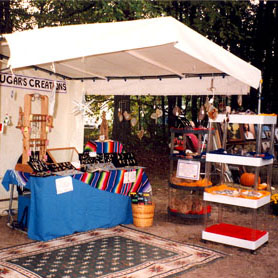 Wire Jewelry Display and Booth Ideas
 Where to Sell Your Wire Jewelry
 How to Choose Wire Temper for Making Jewelry
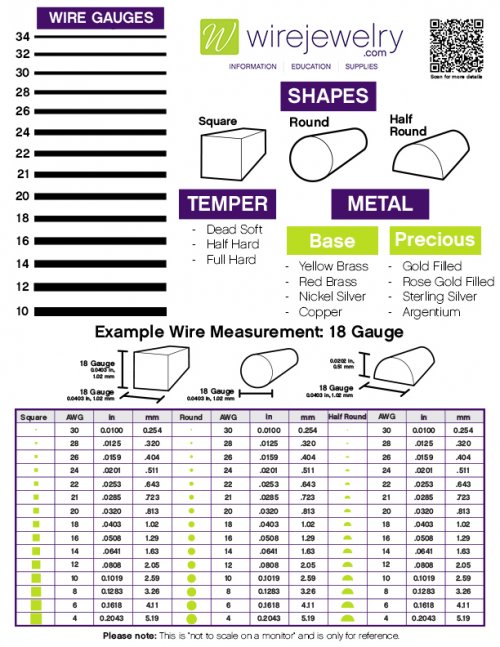 What Gauge of Wire Should I Use to Make Jewelry
 What's a Cubic Zirconia Stone
 Rockhounding - A Beginner's Guide
 What Shape of Wire Should I Use to Make Jewelry
 Gem Profile- Bloodstone
 Gem Profile- Picture Jasper
 Gem Profile- Patterned Jaspers
 Gem Profile- What is Jasper
 Gem Profile- Quartz Introduction
 Gem Profile- Wishful Turquoise
 Gem Profile- Amethyst
 Gem Profile- Fluorite
 Gem Profile- Obsidian
 Gem Profile- Rose Quartz
 Gem Profile- Smoky Quartz
 Gem Profile- Citrine and Ametrine
 Gem Profile- Labradorite
 Gem Profile- Rhodochrosite
 Gem Profile- Moonstone
 Gem Profile- Prehnite
 Gem Profile- Jade
 Gem Profile- Amazonite
 Gem Profile- Corundum
 Gem Profile- Quartz with Inclusions Part 1
 Gem Profile- Quartz with Inclusions Part 2
 Gem Profile- Aventurine
 Gem Profile- Macrocrystalline Quartz
 Gem Profile- Tiger Eye
 Gem Profile- Fire Agate and Iris Agate
 Gem Profile- Amber
 Gem Profile- Ruby Zoisite
 Gem Profile- Ruby Fuchsite
 Gem Profile- Charoite
 Gem Profile- Moldavite
 Gem Profile- Ammolite
 Gem Profile- White Precious Opal
 Gem Profile- Boulder Opal
 Gem Profile- Black Precious Opal
 Gem Profile- Pyrite
 Gem Profile- Opal Introduction
 Gem Profile- Beautifully Colored Jasper
 Gem Profile- Common Opal
 Gem Profile- Lapis Lazuli
 Wire Sculpture Expert Dale -Cougar- Armstrong Interview

The premier place for all your jewelry making needs. The best in wire, tools, cabochons, gemstone beads and more. As well as a superior resource for educational support to help build your jewelry making skills and techniques.
Connect With Us

® 2007 - 2026 Wirejewelry.com Powered by ClaimTheWeb Cart