




Gem Profile- Common Opal
This article is one of a six-part series on Opal. Here is a complete list of our Opal articles: An Opal Introduction, Common Opal, Black Precious Opal, White Precious Opal, Opalized Fossils, Boulder Opal
Almost everyone recognizes the "play of color" or "color flash" in precious opal, which is relatively rare. What many don't realize is that opal as a rock is actually quite abundant.
Material with the same mineral composition as precious opal but without any play of color is called "common" opal.
Glassy, brittle, and often opaque or occasionally translucent common opal can be found worldwide.
Some pieces are attractive enough to be used as gem-rocks.
Plain, common opal can be found all over the world.
Material with the same mineral composition as precious opal but without any play of color is called "common" opal.
Glassy, brittle, and often opaque or occasionally translucent common opal can be found worldwide.
Some pieces are attractive enough to be used as gem-rocks.
Plain, common opal can be found all over the world.

As discussed in our Opal Introduction, opal often fills cracks, seams, vugs, and voids in matrix rocks.
Because it forms near the earth's surface at relatively low temperatures in areas of volcanic activity, opal is frequently found as nodules within solidified volcanic ash, or pumice.
A notable example is Mexican "jelly" opal, a common opal found in volcanic matrix.
Transparent to translucent specimens in bright yellow-orange to cherry red are called "cherry" or "fire" opal named for their color, not because they contain actual fire.
Jelly opal is less brittle than other opals, and clear, brightly colored pieces are often faceted into gemstones.
Cabochons are usually small since the opal forms in pumice vugs. When play of color is present, they are called "Precious Fire Opals."
Jelly opal in matrix is also used for small carvings animals, plants, and sea creatures where the opal highlights part of the subject. Clear opal with little or no color is called "water" or "crystal" opal.
Jelly opal occurs in white, yellow, green, and blue and is found in nine Mexican states.
A few commercial mines exist, but most material today is hand-dug in open quarries and transported to market by burro.
Mexican jelly opal, or fire opal, cut and wrapped in 21-gauge gold filled wire by Beverly Brown
Because it forms near the earth's surface at relatively low temperatures in areas of volcanic activity, opal is frequently found as nodules within solidified volcanic ash, or pumice.
A notable example is Mexican "jelly" opal, a common opal found in volcanic matrix.
Transparent to translucent specimens in bright yellow-orange to cherry red are called "cherry" or "fire" opal named for their color, not because they contain actual fire.
Jelly opal is less brittle than other opals, and clear, brightly colored pieces are often faceted into gemstones.
Cabochons are usually small since the opal forms in pumice vugs. When play of color is present, they are called "Precious Fire Opals."
Jelly opal in matrix is also used for small carvings animals, plants, and sea creatures where the opal highlights part of the subject. Clear opal with little or no color is called "water" or "crystal" opal.
Jelly opal occurs in white, yellow, green, and blue and is found in nine Mexican states.
A few commercial mines exist, but most material today is hand-dug in open quarries and transported to market by burro.
Mexican jelly opal, or fire opal, cut and wrapped in 21-gauge gold filled wire by Beverly Brown

Jelly Opal Cabochons
and
Rough jelly opal
and
Rough jelly opal


Mexican fire opal cabochon, made into a wire ring by Dale Cougar Armstrong.

The term "common" also refers to the opal that comes to us from South America, known as "Peruvian Opal." Although this lapidary material has absolutely no play of color, its delicious variety of colors in blues and pink make wonderful cabochons and beads for the jewelry making industry. Peruvian Blue opal is only mined in one location in the Andes Mountains and it is the national stone of Peru.
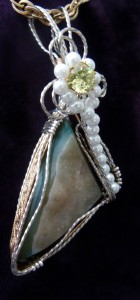
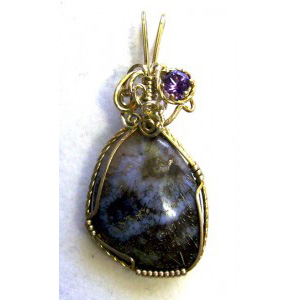
This stone might be a Andean Blue Opal from Peru, although it resembles dyed chalcedony with inclusions. The stone is beautifully wire wrapped in a reversible pendant by D'Arcy Johnson.
This stone might be a Andean Blue Opal from Peru, although it resembles dyed chalcedony with inclusions. The stone is beautifully wire wrapped in a reversible pendant by D'Arcy Johnson.

The most sought-after and rare "Peruvian Blue" is a translucent gemstone that commands high prices.
More common is the opaque blue opal, often showing swirls of white and sometimes hints of pale teal or green, colored by copper. Because it is less expensive, this common Peruvian blue opal is usually made into beads and is sometimes dyed to enhance its color.
To check if your blue opal beads have been dyed, look for uneven color. Plain white common opal can also be dyed blue or pink, often showing similar uneven tones.
If a strand of beads is advertised as "natural" Peruvian blue or pink opal and priced around $40 or less, it is likely counterfeit.
As a designer, I personally prefer the natural artistic swirls and color variations found in genuine, common Peruvian blue opal.
Common Peruvian blue opal rough and cabochons, showing both opaque and translucent areas, with artistic value! Private collection, Dale Armstrong
More common is the opaque blue opal, often showing swirls of white and sometimes hints of pale teal or green, colored by copper. Because it is less expensive, this common Peruvian blue opal is usually made into beads and is sometimes dyed to enhance its color.
To check if your blue opal beads have been dyed, look for uneven color. Plain white common opal can also be dyed blue or pink, often showing similar uneven tones.
If a strand of beads is advertised as "natural" Peruvian blue or pink opal and priced around $40 or less, it is likely counterfeit.
As a designer, I personally prefer the natural artistic swirls and color variations found in genuine, common Peruvian blue opal.
Common Peruvian blue opal rough and cabochons, showing both opaque and translucent areas, with artistic value! Private collection, Dale Armstrong

As a wire artist, I am known for working mainly with natural earth tones and shades of green. However, I do like one pink stone: Peruvian Pink Opal.
The luscious raspberry to pale pink color of this opal gem is completely natural. It comes from the same area in Peru as the blue material, but the mineral content contains iron, which gives this opal its pink hue.
Sometimes strands of beads are dyed to enhance their color, but pink opal is very affordable and can also be purchased as cabochons.
Dyeing chalcedony is the main imitation of either blue or pink opal in cab form.
Beware of products labeled as "Peruvian" or "Andean Opal Chalcedony."
Rough and unpolished slabs of Peruvian pink opal. The rough on the back left was photographed wet to show what it will look like when it has been polished. Private collection, Dale Armstrong.
The luscious raspberry to pale pink color of this opal gem is completely natural. It comes from the same area in Peru as the blue material, but the mineral content contains iron, which gives this opal its pink hue.
Sometimes strands of beads are dyed to enhance their color, but pink opal is very affordable and can also be purchased as cabochons.
Dyeing chalcedony is the main imitation of either blue or pink opal in cab form.
Beware of products labeled as "Peruvian" or "Andean Opal Chalcedony."
Rough and unpolished slabs of Peruvian pink opal. The rough on the back left was photographed wet to show what it will look like when it has been polished. Private collection, Dale Armstrong.

Peruvian Pink" opal cabochons cut by Charlie Armstrong and wrapped into an Argentium silver necklace with freshwater pearl accents by Dale Cougar Armstrong.
and
Pink opal earrngs and necklace by Jackie Morris
and
Pink opal earrngs and necklace by Jackie Morris


There are many other names for common opal, usually based on the locality or its color.
Some examples include "Nickel" opal, a gorgeous green colored by nickel found in Poland, and Tanzania material, which is a beautiful green resembling chrysoprase called "Prase" opal.
Brazil and several North American locations produce opal with fern-like dendritic inclusions, known as "Dendritic" opal.
Common opal is found all over the world, with notable locations including New Zealand, South Africa, and various regions across the United States.
Dendrite opal from Burro Creek, Arizona. Private collection, Dale Armstrong.
Some examples include "Nickel" opal, a gorgeous green colored by nickel found in Poland, and Tanzania material, which is a beautiful green resembling chrysoprase called "Prase" opal.
Brazil and several North American locations produce opal with fern-like dendritic inclusions, known as "Dendritic" opal.
Common opal is found all over the world, with notable locations including New Zealand, South Africa, and various regions across the United States.
Dendrite opal from Burro Creek, Arizona. Private collection, Dale Armstrong.

Although it is called common, as you can see there is a lot of opal material that does not exhibit a play of color that is still beautiful enough to be used in jewelry making of any type, because really, it is not so "common"!
Resources
Print Resources:
Minerals of the World by Walter Schumann, ISBN 0-8069-8570-4
Opals by Fred Ward, ISBN 1887651047
Internet Resources:
www.geology.com
Click Here
www.minerals.net
Click Here
www.wikipedia.org
Click Here
Print Resources:
Minerals of the World by Walter Schumann, ISBN 0-8069-8570-4
Opals by Fred Ward, ISBN 1887651047
Internet Resources:
www.geology.com
Click Here
www.minerals.net
Click Here
www.wikipedia.org
Click Here
Materials

Wire

Beads

Cabochons
Tools

WireJewelry - Ultimate Wire-Pliers Jewelry Pliers with Case, Set of 5
G15-20
- G15-20
- Lesson Quantity: 1.00 pieces
- Purchase Quantity: 1.00 each
- Price: $170.72
- Gold Club Price: $128.04

Bench Tools
Supply Detail
loading...
Change Metal:
This Article requires:
Purchase quantity:
Price: $
Gold Club Price: $
Purchase quantity:
Price: $
Gold Club Price: $
- Category: General Education
- Technique(s): General Education
Dale Armstrong
Other Articles by Dale Armstrong
 Getting Twisted - Jewelry Making Tools
 How to Price Your Wire Jewelry
 How to Measure Gemstones for Settings
 Cool Anklets are HOT
 Inspiration Comes from Everywhere and Every Thing
 Wire Jewelry Display and Booth Ideas
 Where to Sell Your Wire Jewelry
 How to Choose Wire Temper for Making Jewelry
 What Gauge of Wire Should I Use to Make Jewelry
 What's a Cubic Zirconia Stone
 Rockhounding - A Beginner's Guide
 What Shape of Wire Should I Use to Make Jewelry
 Gem Profile- Bloodstone
 Gem Profile- Picture Jasper
 Gem Profile- Patterned Jaspers
 Gem Profile- What is Jasper
 Gem Profile- Quartz Introduction
 Gem Profile- Wishful Turquoise
 Gem Profile- Amethyst
 Gem Profile- Fluorite
 Gem Profile- Obsidian
 Gem Profile- Rose Quartz
 Gem Profile- Smoky Quartz
 Gem Profile- Citrine and Ametrine
 Gem Profile- Labradorite
 Gem Profile- Rhodochrosite
 Gem Profile- Moonstone
 Gem Profile- Prehnite
 Gem Profile- Jade
 Gem Profile- Amazonite
 Gem Profile- Corundum
 Gem Profile- Quartz with Inclusions Part 1
 Gem Profile- Quartz with Inclusions Part 2
 Gem Profile- Aventurine
 Gem Profile- Macrocrystalline Quartz
 Gem Profile- Tiger Eye
 Gem Profile- Fire Agate and Iris Agate
 Gem Profile- Amber
 Gem Profile- Ruby Zoisite
 Gem Profile- Ruby Fuchsite
 Gem Profile- Charoite
 Gem Profile- Moldavite
 Gem Profile- Ammolite
 Gem Profile- White Precious Opal
 Gem Profile- Opalized Fossils
 Gem Profile- Boulder Opal
 Gem Profile- Black Precious Opal
 Gem Profile- Pyrite
 Gem Profile- Opal Introduction
 Gem Profile- Beautifully Colored Jasper
 Gem Profile- Lapis Lazuli
 Wire Sculpture Expert Dale -Cougar- Armstrong Interview

The premier place for all your jewelry making needs. The best in wire, tools, cabochons, gemstone beads and more. As well as a superior resource for educational support to help build your jewelry making skills and techniques.
Connect With Us

® 2007 - 2026 Wirejewelry.com Powered by ClaimTheWeb Cart